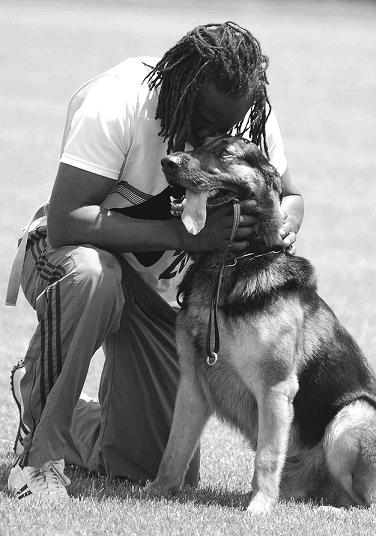
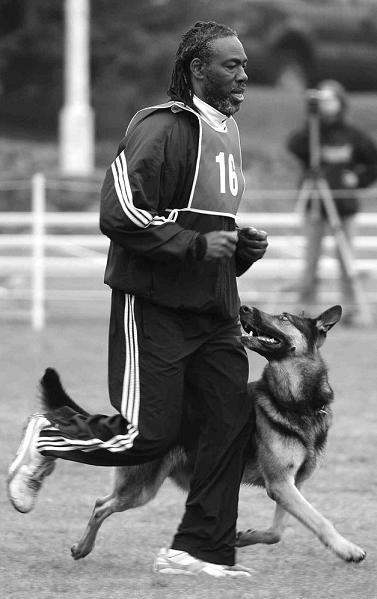
We all know T Floyd as a successful
handler and trainer and have seen him with many different dogs at many big
trials like Regional, National and World Championships, some of the dogs even
self bred. His big smile while on the field especially in obedience is something
you remember once you have seen it.
What many people do not know is that T also has a special gift as a coach. He
has worked with multiple teams and helped them to accomplish their goals. Some
of them managed to get the title they dreamed of at a club trial due to his
help, others won championships. It does not matter if it is a new handler or
someone who is in the sport for many years; he always tries to maximize the
team’s performance and shares his knowledge openly. Furthermore, if you ever saw
him at the sideline when one of his student’s trials you know how much his heart
is in it as well.
 Let
me take you back to a place called “The Hood”. I grew up in one of the roughest
areas of Philadelphia. North Philly was filled with drugs, violence, crime, and
gang wars. My mother was an exceptionally strong woman and she was determined to
keep her children from the streets. I was not allowed to be part of a gang and
furthermore, the gang members feared my mother. So, I was not able to hang out
with the wrong company. At age nine or ten, I spent much of my younger years
training dogs for people in my neighborhood.
Let
me take you back to a place called “The Hood”. I grew up in one of the roughest
areas of Philadelphia. North Philly was filled with drugs, violence, crime, and
gang wars. My mother was an exceptionally strong woman and she was determined to
keep her children from the streets. I was not allowed to be part of a gang and
furthermore, the gang members feared my mother. So, I was not able to hang out
with the wrong company. At age nine or ten, I spent much of my younger years
training dogs for people in my neighborhood.
My reputation began to grow when I was asked by police officers to tease
their dogs and to help with training. Looking back, it is a trip to think about
it; while other kids were looking out of the school window waiting for the bell
to ring so they could go play, I wanted that bell to hurry up and ring so I
could go train my dog! That was my play!
When I was about 12 or 13, I went to work on a milk truck. There, the
storeowner had a litter of German Shepherd Dog puppies. He asked me if I would
like one. I said yes. I took the puppy home and I named him Billy. Mind you, I
neglected to ask my mother if I could have this puppy. She eventually said yes.
I taught Billy all sorts of tricks as well as obedience and protection. So,
Billy and I became known around the neighborhood as a duo. People began to come
to me to train their dogs and they were paying me to do it.
Now, we’ll fast forward to the late 70’s. I started playing music and this
enabled me to travel and I was touring with a group in Washington DC. While I
was on tour I met a young lady who invited me to her job’s picnic. I saw this
guy by the name of Hans Straffer training his two German Shepherd Dogs doing
obedience and protection. I forgot all about my date and watched him train. When
he finished training I saw people petting these dogs and the guy and the dogs
were just chilling after they had this intense training experience. I started to
ask him questions about what it was he was doing. That is how I found out about
Schutzhund.
Then my music career landed me in California where I went to Mandelyn School
for Dog Trainers. There I lived around the corner from a German guy named Erich
Renner who owned a guide dog school and owned a very famous Schutzhund dog named
Bodo vom Lierberg. This dog was the foundation of the breeding program for his
guide dogs. He would walk his dogs every day and I would talk to him about the
dogs and this sport called Schutzhund. That was my second encounter with the
sport.
Fast forward again, still in the state of California, I stopped traveling,
got married and got a job training at a kennel. My skills continued to improve
and I was quickly popular with the clients there. I began training AKC
obedience. Then, an old musician friend took me to a Schutzhund club. Once
there, I knew this was for me! So, I joined the club and I felt like I was able
to understand some concepts as well or even better than the trainer there. I met
Ann Fransblau and Vernon Crowder. They knew Dean Calderon and thought I should
meet him. So, they had him come down to our club. Dean was the one who taught me
what Schutzhund was all about. He introduced me to Fritz Biehler, Helmut Koenig,
Dr. Helmut Raiser and Reinhard Lindner, just to name a few. I gained so much
knowledge from these legends and I took something from all of these masters and
put it together to form who I am now and I am still learning.
CR: You really seem to enjoy being a coach. What do you like about it?
What do you enjoy in particular?
Coaching is a passion just like competing. I like challenges. I learned from
my mother how to root for the underdog. The majority of people form certain
opinions and ideas about what others may or may not be able to achieve. They
speculate on who should be able to accomplish this or that. I like to prove them
wrong.
You must have a trusting relationship with the players and you cannot coach
every player the same way. You must really know them and treat them as an
individual. You only get to know their learning style by knowing the person.
Coaching involves giving of oneself; to expand on that, it means love,
friendship, trust and a relationship between student and teacher and that is
what I love most about it. There are many good dog trainers, but that does not
necessarily make them effective teachers or coaches. When you truly have a
loving and trusting relationship with your student you can tell them the truth
through love in order to help them improve.
Many trainers are fearful to tell the truth or do not want to admit that
there are questions they cannot answer mostly because they do not want to lose
clients. There will always be things we do not know, all we need is to know
where we can find that information, who to ask and not to let our ego be in the
way to do so.
Even worse is when they do not want to see students becoming too good and
they may exceed their teacher. A jealous heart will destroy a coaching
relationship. God has given us all gifts. I am blessed that he has given me the
gift of loving people and dogs. Having Christ in my life has humbled me. It has
made me more compassionate about the feelings of others.
I enjoy watching people grow in their relationship with their dog and
ultimately them having success in teaching their dog.
CR: If you decide to train with a person respectively coach a team, what
is most important to you about the dog/handler team?
 Most
important for me is that the person has a loving heart for people and dogs. To
quote Mother Teresa, “It’s not what you do but how much love you put into it
that matters”. It is important that the handler wants to train his/her dog and
compete for the right reasons. The dog must never become the person’s ego. It is
very sad to see someone attempting to credit themselves, at any cost, through
their dog. Fairness toward the dog is paramount. There must be a love
relationship between the handler and the dog. If that relationship is not there,
training becomes an impossibility. Put yourself in the dog’s place as a student,
would you learn more from a teacher that you knew would be fair and have a
vested interest in you learning the material, or from a teacher that became
easily frustrated and unfair when you did not comprehend the lesson?
Most
important for me is that the person has a loving heart for people and dogs. To
quote Mother Teresa, “It’s not what you do but how much love you put into it
that matters”. It is important that the handler wants to train his/her dog and
compete for the right reasons. The dog must never become the person’s ego. It is
very sad to see someone attempting to credit themselves, at any cost, through
their dog. Fairness toward the dog is paramount. There must be a love
relationship between the handler and the dog. If that relationship is not there,
training becomes an impossibility. Put yourself in the dog’s place as a student,
would you learn more from a teacher that you knew would be fair and have a
vested interest in you learning the material, or from a teacher that became
easily frustrated and unfair when you did not comprehend the lesson?
CR: You are a very “intense” dog sport person, a bit of a fanatic like
many of us. Do new people to the sport have a problem with that? Do you catch
yourself crossing the line and asking too much from a team you train with?
Most of the people that I have trained were pretty new when they came to me,
or knew very little. I like to train new people. I find that they follow
directions more intensely than people who have been around the sport for a
while. They are refreshing and some of these students are having great success
with their dogs.
I am actually not as intense as some would make me out to be. I am pretty
good at reading people so I can get a feel for someone pretty quickly as to
whether they require me asking more or less of them. Like anyone, I make
mistakes, so there has to be a trusting relationship between me and the person
whom I am training.
I love my students and the dogs; they understand that it is all about
training, that it is never personal.
CR: If you could name one thing you cannot deal with, what would it be? Be
honest – your answer will give some of your students the chance to never do
that!
That could possibly be a very long list, but since you limited me to one
gripe I would have to name the biggest one. I cannot handle abuse toward dogs,
or people who allow their personal issues to be taken out on the dog. Dogs did
not ask to do Schutzhund, they do it because they want to please their masters.
Dogs love unconditionally, they do not care that you buy them a nice bed or the
best dog food, they want your love. Love is a verb, it is an action word and it
is your job to show them your love.
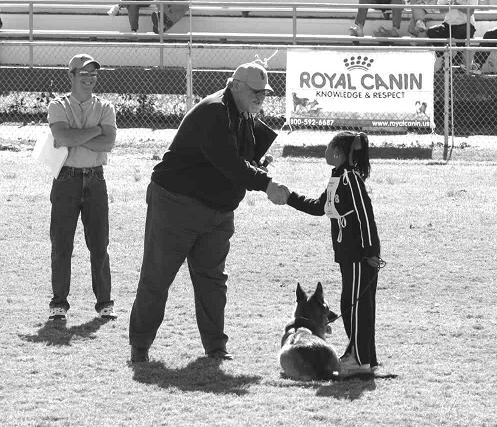
CR: You coached your daughter Daio and she was the youngest National
competitor ever in the history of USA at the 2004 Nationals. How was it for you
to get the team ready for such a big trial?
I found it very easy because I coach my daughter every day of her life. My
wife and I raised her with love and discipline. She had the opportunity to be
around two of the best dog trainers I know, Dean Calderon and Fritz Biehler. She
wanted to do it more than I wanted to. There were times it was freezing outside
and I tried to convince her to go inside, but she was so driven. I was training
with others and she would be just getting off of the bus from school. She would
run and change her clothes so she could come and train. Daio has been around the
sport her entire life. She has a dominant personality and a true love for the
dogs so many aspects of training come to her very naturally. We had a lot of
fun!
CR: How did you feel as a Dad seeing your daughter out there?
I almost had a heart attack. I was so nervous. We were having fun at home
training but then it got serious. She had to go out there by herself and I could
do nothing but watch. That was my baby out there. Most people don’t know this,
but the dog my daughter was training with became ill. So the day before the
competition started the Trial Chairman Lyle Roetemeyer and the President Jim
Elder allowed her to switch dogs. Then my heart attack became really scary
because she was now out there with a dog that she had not trained with. However,
she was determined to get on that field. The rest is history.
 CR:
Was it harder for you to coach her than other students?
CR:
Was it harder for you to coach her than other students?
No. The key to coaching people is the love and trust in the relationship. It
was easy because all of those elements were there with my daughter. Training
dogs was like going to the playground.
CR: What is more difficult for you, dealing with the training of the dog
or dealing with the handler at the end of the leash?
That is a very easy question. You probably can answer that one yourself. Dogs
come very easy to me. I can see what the end result will look like before I have
done it like a builder knows what the house will look like before it is done. My
job as a coach is to help the handler find the best way to train their dog
without losing their own way of doing things. As a coach, I have to consider
that everyone does not have the same abilities in regard to training.
In our country, we have many different cultures. That means that everyone
does not see the world as you do. So, I have to know and employ many different
strategies. That is why a coach must know many different techniques. The
difficulty is to explain the process to others. People become confused when they
cannot follow everything that is going on and they are asked to trust the
teacher. It is like getting lost; when you are lost you feel kind of helpless
and nervous. However, once you find your way, you get this really good feeling.
Dog training is about the moment; the moment that is taking place right now.
Many times I have to worry about the dog first to capture the moment that will
give the dog a successful training session. We all know that timing is crucial
in training animals. That is when that trust between teacher and student really
becomes important.
Overall I find that women have more patience and are more willing to trust a
person. You know how we men like to know everything right away. Again, timing is
crucial, by the time you explain what is going on you will have lost the moment
for the dog and that can sometimes throw your training weeks back. I like to get
the point across first so the dog can have a successful training session, then I
can go back and explain to the student what it was that we were doing. Most
trainers or coaches take the students out of the picture, I do not do that, I do
not think that this good for the student or the dog.
CR: In trials it is always harder for me to see a friend compete than to
be on the field myself. Being a spectator makes me feel so helpless and
sometimes I have a hard time watching. How is that for you?
It is the same way for me, I want to tell them they are walking too fast or
too slow or to praise the dog or just to breathe. It is hard because you do not
want to see them have a bad experience, at the end of the day all I want for
them is that they enjoy themselves and have a good time.
CR: What would be the ultimate satisfaction for you as a coach? What is
your dream?
Each coaching experience is very special and has its ultimate satisfaction
for me. Every time I coach I learn something. I want to stay there, in that
moment. I do not really want to have an ultimate coaching goal, because I never
want to see it end. I enjoy it so much. Each day is a new challenge.
Here a list of some
of T’s recent “students” and their success:

Dana Palumbo
with Nando vom Schloss Zweibruggen
2008 4th place USA
Nationals
2008 Vice Champion
New England Regionals
2007 North American
SchH3 Vice Champion
2007 Vice Champion
Northeast Regionals
2006 SchH2
Northeast Regional Champion
2006 North American
SchH1 Champion.

Pedro Jimenez wtih
Alex vom Eisenhaus
2007 South East
Regionals 3rd place
2007 North American
Championship 6th place
HOT Handler 2006
Universal Sieger
Glyn Clayton with Lex
Iluze
HOT Handler SchH3
Samantha Jimenez with
Hellequin vom Eichenluft
Newest student at age 6, and my
goddaughter, received her BH title in November of 2008. It is amazing to watch
her read and train the dog. It brings so much joy to my heart. She is such a
natural! You can look for her at the Nationals very soon.

Carlos Rojas with
Ikke v.’t Heukske
2003, 2005, 2006 and
2008 North American FH champion
2004 North American Vice
Champion
2005 and 2008 AWDF FH
Champion
Carlos Rojas with
Branco vom Banholz
2008 Northeast Regional
Champion w/ High Obedience
2008 USA National Vice
Champion w/ High Obedience
Larry Vinzant with
Karlo vom Floyd Haus
2009 South Central
Regional 3rd place
2008 German Shepherd
Nationals 8th place
2008 South Central
Regional Vice Champion with High in Protection
2007 South Central Vice
Regional Champion w/ the only V in obedience
Sue Maturo with
Pascha vom Scheldetal (Rottweiler)
2008 USRC Vice Champion
Paige Branham with
“Kita” Blitzgtrahl von Moeller Hof (Doberman)
2006 SchH1 Northeast
Regional Champion
Jane Hobson with Ox
or Overnite Express (Rottweiler)
SchH3
Mark Saccoccio with
Briska vom Feenwald
2009 Working Dog
Championship 5th place
2009 Southwest Regionals
4th place
Article written by
Claudia Romard
Schutzhund USA
Magazine July/August 2009 (p. 12-16)
)
)
)
)
)
)
)

